The Remove Related Elements feature in Adobe Photoshop Beta
Victoria Pavlov
8 Oct, 2026
Hello everyone, and thank you for stopping by. I appreciate it very much.
Today, I could not wait to write my blog post! Why? Because the Photoshop team released a new, magical tool in Photoshop Beta: the Remove Related Elements feature. This tool will help so many creatives across so many workflows. This post will be short, but packed with a lot of magic! Anyone who works with image retouching has run into situations where you need to remove an object along with its related elements. Typically, we had to do this step-by-step: first removing the main object, and then cleaning up the shadows, reflections, and other details connected to it. Now, we can do it unbelievably fast with just one single click! Can you believe it? Let me show you how.
Open the image you want to work with in Photoshop Beta (you can download Photoshop Beta from the Creative Cloud app).
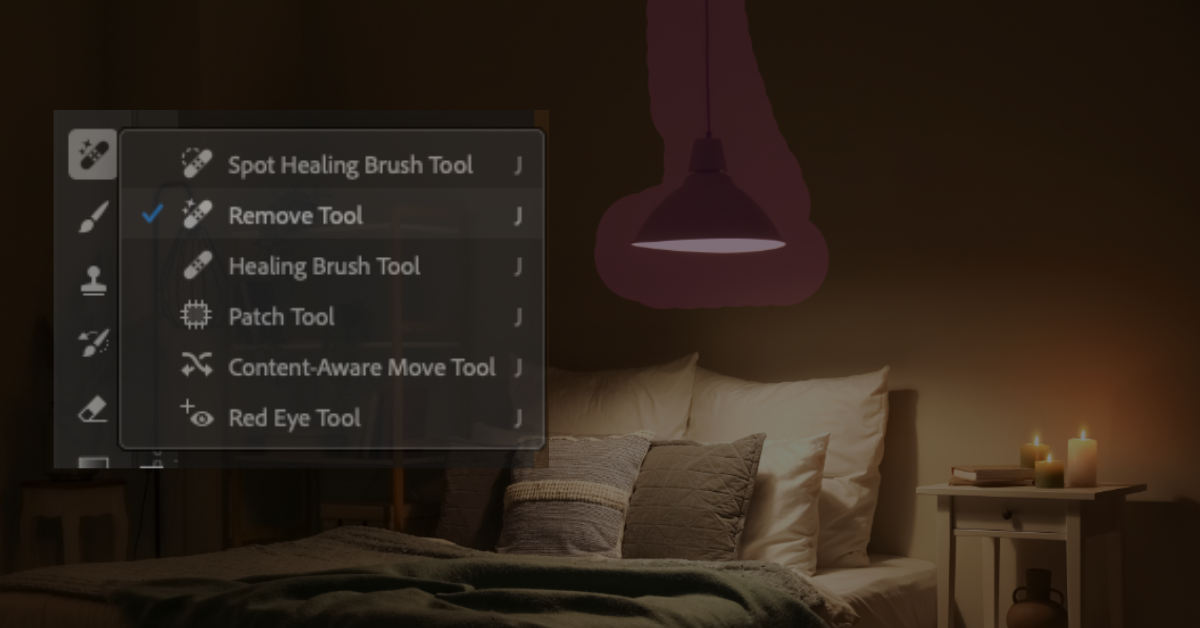
In the toolbar, select the Remove Tool
Now, adjust the Remove Tool settings in the Options bar:
Set Mode to Generative AI on. Set Generative AI processing to Cloud.Change Remove to Related elements Uncheck “Remove after a single stroke”
Using the Remove Tool, brush over the area you want to remove, then click “Remove” in the Contextual Task Bar.
And that’s all there is to it! Photoshop does the heavy lifting for you.
It will automatically generate a new layer while preserving your original, making the entire workflow completely non-destructive
I know, I know… you’re probably rushing to download Photoshop Beta right now! We’ve dreamed about this kind of magic for so long—and now that it’s here, creating is going to be so much fun.
Tools like this give us back what matters most: more time to focus on pure art and storytelling instead of tedious pixel cleanup. Go play with it, experiment, and have fun making your own creative magic today. See you in the next post!
Adobe Firefly Boards
Victoria Pavlov
5 Oct, 2026
Hello and welcome, everyone. I am happy and grateful to see you here. Today we will talk about Adobe Firefly Boards.
Over the last few months, I have been speaking at several public engagements, and one of the topics I discussed was Firefly Boards. My audience was so engaged and inspired by how I implement Firefly Boards into my workflow. I received so many questions and didn’t have time to answer them all, so today I’ll address your questions. Shall we start?
For me, Firefly Boards is a space for ideation—it is my vision board with all the necessary tools to bring my imagination to life. I start all my projects by creating a new board dedicated to that specific project. It keeps me organized and makes it much easier to communicate and collaborate with team members or clients by sending a single link. To create a new board, go to firefly.adobe.com and sign in with your Adobe ID. On the left side of your screen, you will see Boards.
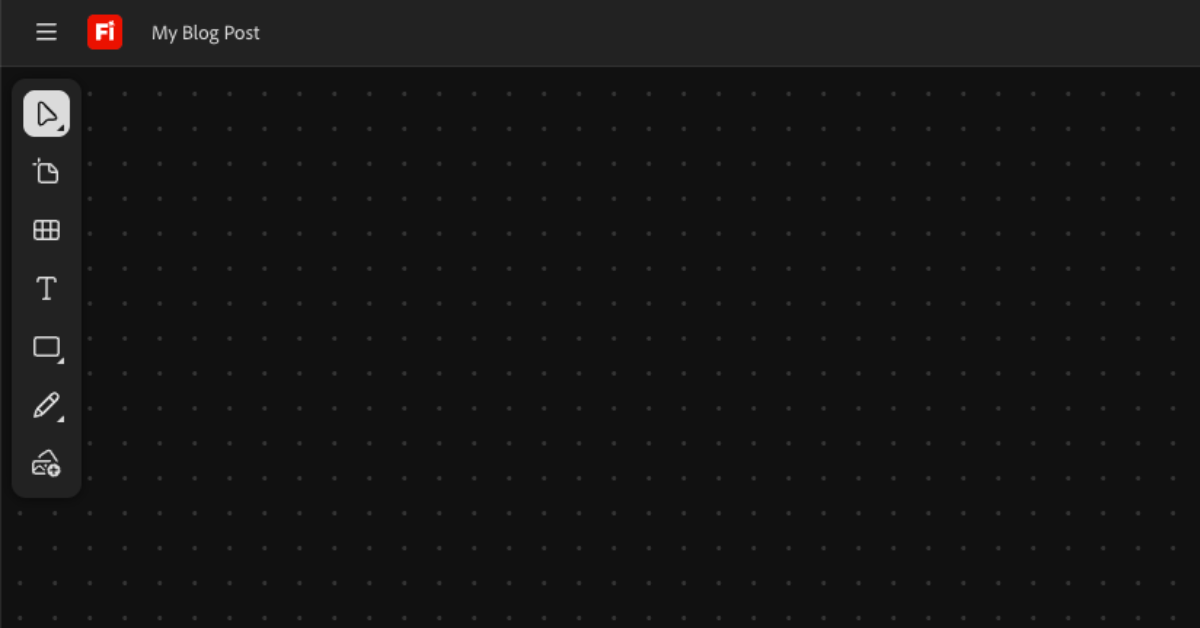
Click on Boards, and you will be redirected to the Boards welcome screen, where you can start a new board or access previously created boards. To create a new board, click on Create a new board.
Give your new board a meaningful title. Believe me, it will help you dramatically once you have more than one board.
Congratulations, you have created your first Firefly Board! Now let’s bring all the files for your project onto the board.
Let’s start by bringing in images from your device or Adobe Cloud storage.
If you want to organize the board’s assets (and I recommend doing so), select all the assets you want to organize, click the ‘Arrange’ icon on the toolbar at the bottom of your selection, and choose your preferred arrangement type from the drop-down menu.
You can search for and import assets from Adobe Stock directly onto the board. Click the Adobe Stock icon, type what you are looking for into the search field, and then click and drag your chosen image directly onto your board. Yes, it’s really that easy!
At the bottom of your screen, Firefly Board displays the toolbar, which you can use to generate images, create videos, or apply ready-to-go presets.
Firefly Boards offers a variety of AI models, including Adobe’s native Firefly model—which is commercially safe—as well as partner models, giving us plenty of choices.
Simply type a prompt describing what you want the AI to create. A more descriptive prompt will yield a more detailed image, as you are telling the AI exactly what you want. You can also specify the model you want to use and choose your preferred image aspect ratio.
Using the toolbar, you can edit your image and access other helpful tools that Firefly offers. I encourage you to explore these options!
I love bringing my color palette onto my board. It keeps all my project assets in one place: easy to keep organized, easy to access, and simple to share with just a single link.
Tip: You can zoom in and out on the board using Cmd + / Cmd – (or Ctrl + / Ctrl – on Windows)
Adobe Firefly Boards offers so many features you can add to your creative toolkit. Using these tools, you can take your ideation board to the next level. Firefly Boards makes putting an ideation board together much faster, with so many helpful tools right at your fingertips. Plus, the visual customization makes the whole process even more enjoyable.
My 4-Step Ideation Workflow To put everything we just covered into practice, here is the simple sequence I follow to move from an initial spark to a finished concept:
Set the Mood & Palette: Start by bringing in your color palette and reference images to lock in the project’s visual foundation.
Generate & Explore: Use prompts to test concepts, try out variations, and explore new directions right on the canvas.
Curate & Organize: Pull in complementary Adobe Stock assets, group related ideas, and use the Arrange tool to keep everything tidy.
Share for Feedback: Generate a single link so clients or collaborators can see the full visual story in one view.
Adobe Firefly Boards offers so many features you can add to your creative toolkit. Using these tools, you can take your ideation boards to the next level. It makes putting an entire vision together so much faster, with intuitive tools right at your fingertips—and the visual customization makes the whole process genuinely enjoyable!
Have you started using interactive boards for your project ideation yet, or do you still stick to traditional moodboards? I’d love to hear how you keep your creative assets organized—drop your thoughts or favorite workflow tips in the comments below!
Adobe has released a new beta feature: Relight.
Victoria Pavlov
28 Sep, 2026
Hello my readers, and welcome. I want to apologize for the long absence. I am back and looking forward to chatting with you.
Today, I want to share my excitement about a new feature in Photoshop Beta. Adobe has released a new beta feature: Relight. I could talk about Relight for a very long time, and I can show you so many different use cases where, without Relight, everything would take much longer, be slower, and not be enjoyable. I fell in love with this feature at first sight, and now you will see why.
Open the image you want to work with:
Layer > New Relight layer
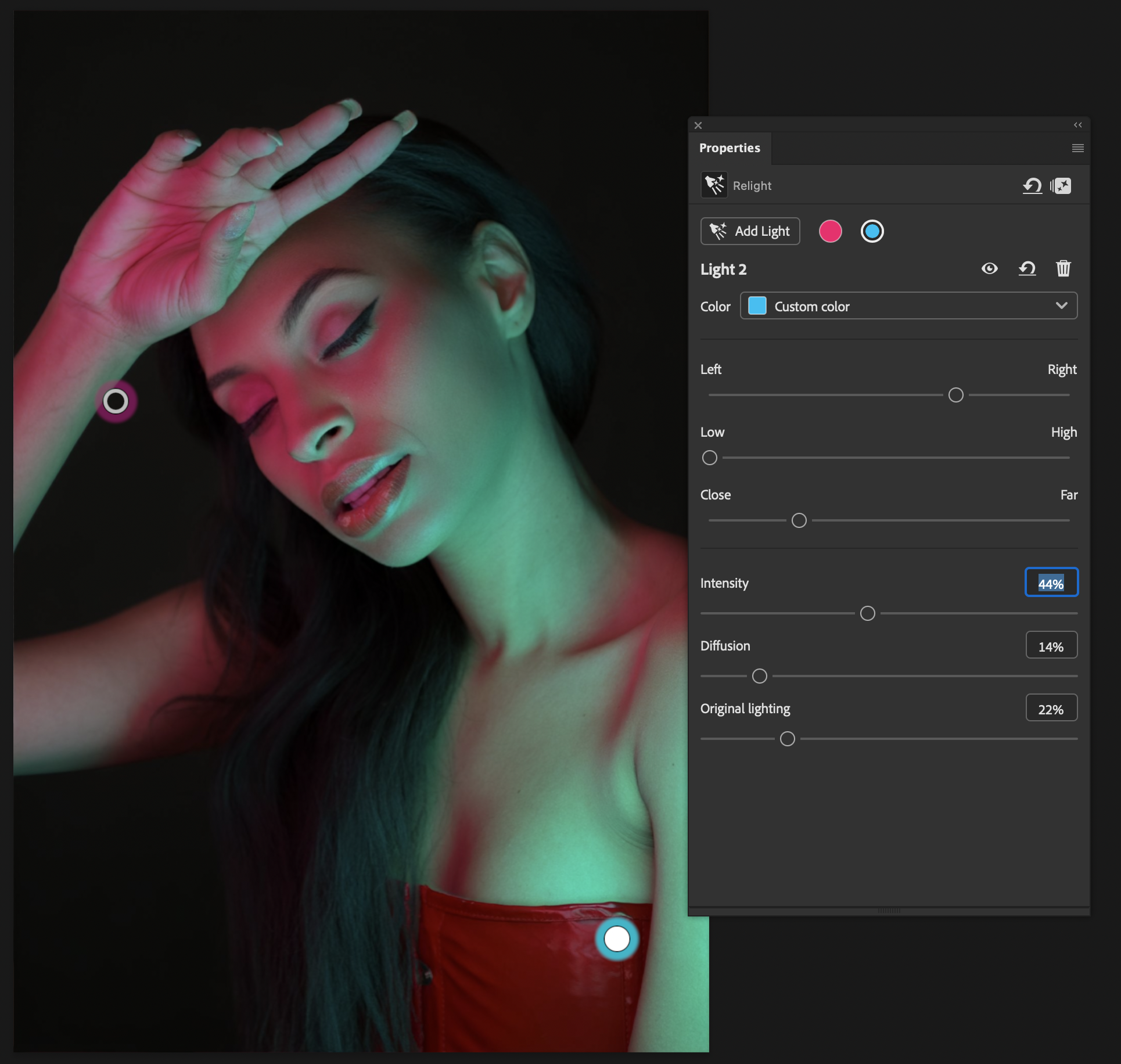
Now you can adjust the new light (which appears in the center of the image) by repositioning it to any location on the canvas. You can do this directly on the canvas (click and drag) or by using the Left-Right, Low-High, and Close-Far sliders in the Properties panel. You can position the light source inside the canvas or even outside of it (as a photographer, I appreciate this very much!). Also, you can modify the light through the contextual task bar.
You can adjust the intensity of the light, the diffusion, and even the original lighting.
Changing the light color is so easy. Just expand the Color menu and you will be able to pick a color from the dropdown or use your own by clicking on Custom Color.
In the image below, I changed the light color to pink, increased the diffusion, and brought the intensity of the original lighting down.
To add another light, click on Add Light in the Properties panel or in the contextual task bar.
You can adjust the new light in the same way you did with the first one. I moved the new light down and changed the color to blue.
You can add as many light sources as you need. It’s up to you, your client, your style, and the image. But with this particular image, I wanted to create deep lighting, just like I love doing in my photography studio.
The Relight feature is non-destructive. Photoshop creates a new Relight layer, keeping your original layer safely underneath.
In the second example, I just wanted to add one light to brighten up the areas hidden in the shadows, and I changed the color as well.
In this image, I kept the original light as it was, but I positioned the new light at the top left side where the image has the most shadow. I changed the color of this light to blue, brought the intensity of the light down, and increased the Diffusion value.
As you can see in the two examples I shared with you, the possibilities are endless. Using Relight, we can slightly adjust the light in the image to improve it using just one extra light. Or, we can use different lights with different colors—or the same color—to add splashes of artistic expression to the image. For a photography studio workflow, Relight is like bringing a physical strobe directly onto the canvas. In a photo compositing workflow, Relight relights every single aspect of your composition to make it exactly as you envision it.
If you know me, you know that I only share what I actually use, what excites me, and what I find valuable in my studio. This is one of those tools that I will be using all the time. Relight has opened the box to unlimited lighting possibilities with just a few clicks, and that truly excites me. So let me know, how will you use Relight?
Coloring Pages in Adobe Fresco
Victoria Pavlov
11 Sep, 2026
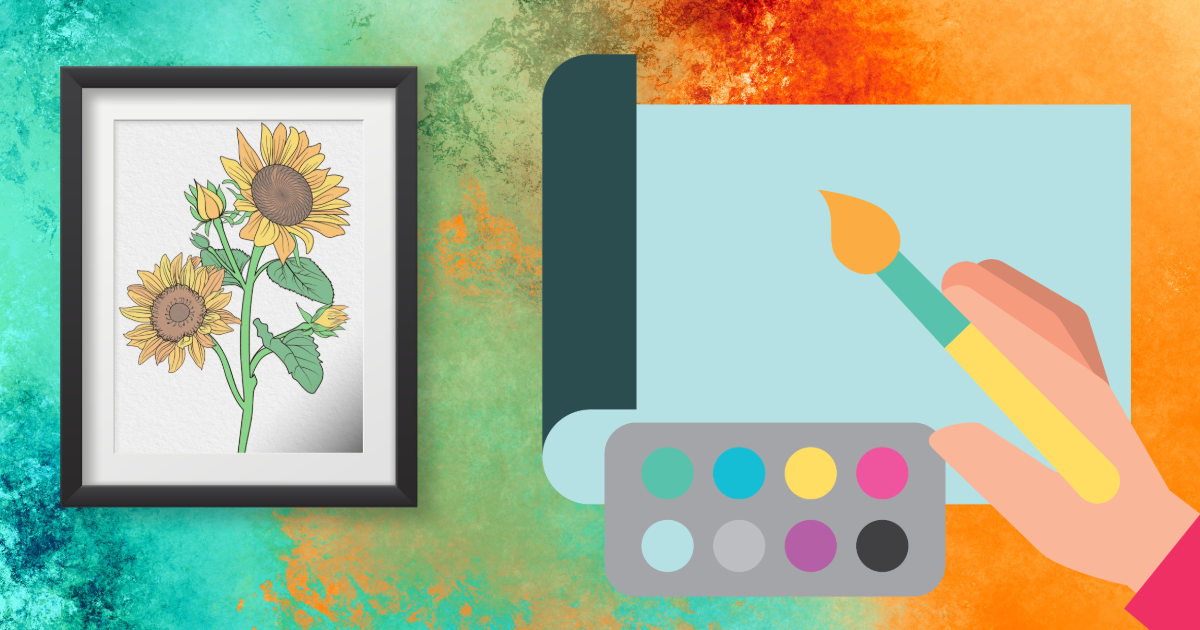
I couldn’t think of a better time to share a new feature in Adobe Fresco than on a Friday evening! Friday evening is when we wind down and look forward to the weekend, and the Coloring Page feature in Adobe Fresco is the ultimate art-meditation tool for a relaxing couple of days. You don’t have to draw a coloring outline from scratch—the Adobe Fresco team has you covered with built-in templates so you can jump straight into creative relaxation. There are several designs to choose from, so everyone can find a page they love, and I hope the team will add even more options very soon. How to get started:
Download Adobe Fresco (if you haven’t already)—it’s a free app for your mobile device or tablet!
Tap Coloring Pages directly from the home screen (or choose it under Create new).
Pick your favorite brushes and colors to create some magic, and you’re ready to go! It really is that simple.
I truly believe art belongs to everyone. It is self-expression, our voice, and our way of communicating with the world. Everyone has the ability to create. Art also carries incredible healing power, and coloring is one of the most soothing, meditative ways to experience it. So pause for a moment, open Adobe Fresco, and feel the power of art meditation!
The Illustrator Features I Can't Work Without (Part1)
Victoria Pavlov
11 Sep, 2026
As an artist and illustrator, my studio workflow relies on tools that don’t just get the job done, but actually keep the creative spark alive. Adobe Illustrator is constantly evolving, and while classic vector techniques will always have their place, several features—both fresh updates and hidden gems—have completely transformed how I build artwork. They cut out tedious, repetitive tasks, smooth out frustration, and open the door to ideas that felt impossible just a short while ago. In this first part of my series, I’m pulling back the curtain on the specific tools and features I reach for every single day to bring dynamic energy, speed, and joy back into vector illustration.
1: The Fidelity Slider in the Pencil Tool Sometimes we are skeptical when we hear that a single feature in a tool can make a huge difference, but the Fidelity slider is one of those game-changers. That single slider makes all the difference in how smooth a path is when using the Pencil Tool. The Fidelity slider tells Illustrator to generate fewer anchor points and aggressively average out small hand jitters, creating sweeping, fluid curves. If you need tight adherence to intricate sketches, keep it one notch below maximum smoothness to retain sharp turns.
2: The Blend Tool: Pure Creative Magic If you haven’t explored the updated Blend Tool lately, you’re missing out on serious creative freedom. Testing out different options often delivers stunning, unexpected color transitions that go way beyond the original plan. Try blending across a custom spine or mixing contrasting palettes—you might just stumble onto your new favorite visual effect!
3: Updated Gradient Presets I use gradients constantly in my workflow, and Adobe’s recent update to the preset libraries has been fantastic. They’ve added a fresh batch of modern presets that I’m really enjoying, and having these ready-to-go options speeds up my creative process tremendously. Even when I customize the color stops to match my artwork, starting with a strong preset cuts my setup time in half.
4: Making Custom Patterns in Illustrator As an illustrator and business owner, I am always creating custom patterns in Illustrator. I love turning my own hand-drawn motifs, pencil strokes, or vector shapes into editable, seamless repeats. Simply select your artwork and go to Object > Pattern > Make. From there, you can create endless pattern variations directly from your designs. The best part? You can adjust the artwork directly on the canvas and preview every change updating in real time!
5: Custom Brushes Custom brushes are a huge part of my illustration process. I am always updating my brush library with new brushes for every project and workflow. Creating a custom brush and bringing it into my artwork takes my creative joy to a whole new level! In Illustrator, making your own brush couldn’t be easier. Quick Tip: Starting with a single vector shape, you can create entirely different brush types—or make endless variations of the exact same brush!
6: The Width Tool What can I say about this tool, except that it’s pure magic for transforming the most boring, static stroke into something dynamic and expressive? The best part is that it’s so effortless to use, sometimes I catch myself thinking, “Can it really be this simple?” Instead of being stuck with a flat, uniform stroke weight, the Width Tool lets you interactively sculpt the thickness at any anchor point or anywhere along the path.
7: Objects on Path Objects on Path in Adobe Illustrator lets you attach and distribute repeated shapes, icons, or vector elements directly along the contour of any open or closed curve with live interactive controls. The Objects on Path feature turns the tedious chore of manually moving and aligning objects along a curve into an effortless, lightning-fast workflow.
8: Intertwine Making overlapping objects look truly interwoven has always been somewhat challenging. With the Intertwine feature, that entire process is so much faster and easier. The Intertwine feature allows you to seamlessly weave overlapping vector paths, shapes, text, or strokes over and under one another without cutting paths, expanding strokes, or messing up your layer structure.
9: Mockup As a freelancer, I work on a lot of branding projects for both my clients and my own business, and the Mockup feature makes the presentation process completely seamless. The Mockup feature in Adobe Illustrator lets you realistically wrap vector art, patterns, or typography around 2D raster images—such as t-shirts, mugs, packaging, or tote bags—directly on the canvas. It automatically conforms your artwork to surface curves, perspective angles, and natural fabric folds.
10: The Turntable Turntable in Adobe Illustrator takes a single flat 2D vector object or character and automatically generates multiple rotated angles and perspective views. The Turntable is one of my favorite tools in Illustrator. It truly makes what felt impossible not so long ago a reality! I can rotate any artwork in any direction—up, down, or around—and place preview angles directly on the canvas. On top of that, I can adjust each view separately. Starting from just a single character, I can use Turntable to generate dozens of different angles and variations, and switching up the color palette gives me completely unique results every time!
This is where our creative fun begins! Taking time to just sit down and make art is so important, and I want to make it as relaxing as possible for our community.
I have put together a full digital project kit so we can paint this cozy autumn pumpkin together. Let’s skip the blank-page stress—your download includes my original sketch, a custom color palette, and step-by-step instructions. It is the perfect way to unwind and play in Photoshop or Adobe Fresco.
Head over to the link in my bio to preview the project and grab your files from The Digital Canvas Toolkit. I can’t wait to see what you create!
The Tool I've Been Waiting For: Adobe Illustrator's AI Assistant is here!
Victoria Pavlov
18 Jun, 2026
Hi everyone! Today is a day I’ve waited for a long time because I can finally share an incredibly helpful tool the team released in Adobe Illustrator!! I am talking about the AI Assistant. Note: The AI Assistant is currently available in the Adobe Illustrator public Beta. You can download it directly from your Creative Cloud app.
You know me—I am always excited about technology and creativity, and I love sharing the tools I find genuinely helpful. Today is definitely one of those days. The AI Assistant in Illustrator is a tool I started using every single day after trying it. It represents the true core of what an AI Assistant should be. By using it, I can finally concentrate on the important tasks, like creating my art, building projects, and focusing mostly on the creative side.
If you’ve attended any of my presentations (whether on a conference floor or online) or read my posts, you know I am always asking you to name your layers! I know the importance of it based on my own workflows. When I create art, I get excited and pay attention only to the creative process. And by the end… it’s a disaster. Usually, I have 200+ layers (at least!), and when I need to find a specific layer to adjust, it takes more time to find it than it did to create the actual art. Now, with the AI Assistant, I can finally stop paying attention to something that is boring (at least to me): organizing my layers!
I created this cute parrot, and of course, I have tons of layers. And yes, I did not spend time organizing and renaming them.
So, I will ask the AI Assistant to organize my layers. I can do this by clicking on “Get Started” or clicking on “Organize,” and I will go with “Organize.”
Once I click on “Organize,” the assistant suggests what type of assistance I might need, such as “Rename all layers as per document.” That’s good, but I want something else, so I asked the AI Assistant to: “organize all layers, delete hidden layers, rename all layers.
The AI Assistant started working on the task, and here we have full transparency into exactly what the Assistant is doing.
Once the task is completed, the Assistant will let you know and show you everything it did.
It will also suggest future tasks it could handle for you. If there is anything from the suggestions you want to do, simply click on it! Or, if you have a specific task in mind, just ask the Assistant to do it by typing what you want in the prompt/text area.
Tip: If you ever need to undo the latest Assistant task, simply go to Edit > Undo Assistant Action.
Very often in my workflow, I need to pick a color from an image. Now, I can do it much faster. Well, let me correct myself: I will ask the AI Assistant to do it for me! This is my Frida that I created in Illustrator, so I asked the Assistant to create a color palette from the image.
Once again, I have full transparency into exactly what the AI Assistant is doing, and when it finished the task, it showed me what it did and the result. Look at this!
These are just a few examples of how the AI Assistant in Adobe Illustrator can help you minimize boring and repetitive tasks. Along with the examples I showed you today, I use the Assistant to rename my artboards, get my document ready for print, and export my artboards.
This is what I was so excited to share with you today. If you have any questions, please don’t hesitate to ask.
Also, I am so excited to announce that I am starting a new weekly live stream: The Hands-On Illustrator: Vector & Vision with Victoria. Join me every Friday at 1 PM ET to talk, explore, and create vector art using a mix of classic and new tools in Adobe Illustrator. I can’t wait to see you all there!
AI: A Tool, Not a Replacement—A Personal Reflection
Victoria Pavlov
25 May, 2026
Hello everyone, and as always, thank you so much for stopping by and for all your support. I appreciate it very much. Every month, I receive a flurry of questions about my thoughts on AI—this tidal wave spreading across every corner of our lives. I’ve written about this before, but it bears repeating: AI evolves daily, weaving itself into everything from our creative workflows to the mundane tasks of everyday life.
But how we engage with this technology matters. I see people using AI in two very different ways:
1. The “Default” Trap In this scenario, we ask AI a question or give it a command, and we accept the answer as gospel. We think, “I would do it differently, but it’s AI—it knows better.” This approach is dangerous. When we stop questioning the output, we risk degrading our ability to make decisions, our resourcefulness, and our unique perspective. Worse, we often delegate tasks to AI that we could do faster ourselves, just to buy more time to scroll through social media—content fed to us by algorithms that already “decided” what we should see. By relying on chatbots for everything and letting algorithms curate our reality, we risk losing our individuality, our unique understanding of the world, and even our human desire for genuine connection.
2. The Creative Partnership In this scenario, we are the architects. We have the ideas, the vision, and the skills, but we use AI as a tool to bring those concepts to life. Whether it’s learning a new hobby, coding a smart home automation, or using AI to assist in photo restoration and retouching, we are using the tech as it was designed: as an assistant. Personally, I love having AI in my toolbox. It helps me bridge gaps and execute my vision, but the vision itself belongs entirely to me. It doesn’t make my decisions; it just helps me get the job done.
Is Creativity Dead? This is the question I hear most often: “Do people still want original art?” My answer is an emphatic yes. People crave work born from the human soul, vision, and passion. AI cannot replicate that. It lacks human experience, emotion, and the ability to pour life into a canvas, a melody, or a poem. It’s not coming up with something new. Because we as humans project our own emotions onto art, that connection is what makes it unique.
On the other hand, AI gives people who never felt they had the “skill” to paint a way to express themselves. My mother, a musician who felt she couldn’t paint, found a new outlet through generative AI. I believe it is always important to create, regardless of the tool. However, I believe we should be precise with our language: “Generative Art” is the perfect term for this imagery. It is a distinct category, separate from traditional or digital art created by hand. There is room for both, and only you can decide which tools are right for your journey.
A Final Thought We have more choices than ever. We have traditional mediums, digital tools, and AI assistants. But now, more than ever, we must remember that our humanity is our greatest power. AI is a helper, but the “originality” must remain in human hands. It’s time to lean back into real human interaction. No social media platform or AI bot can provide the feeling of being loved, appreciated, or truly connected. That comes from a phone call, a text to a friend, or visiting a real person’s website or blog. I want to see the messy art studio. I want to see the “not perfect” paintings. I want to see the musician’s studio where the music was born through struggle, not just perfect, algorithm-corrected notes. I want to see the poet’s basket full of discarded drafts before that one perfect rhythm was found. That is what real life looks like. It isn’t the “perfect” feed projected by an algorithm. So the choice is yours: decide what you want to see, decide who you want to be, and choose your tools with intention.
Sketch to Vector in Adobe Illustrator Beta
Victoria Pavlov
8 Apr, 2026
Hello everyone! I am so happy to see you all here today, and as always, thank you so much for stopping by. I appreciate your support!
Today, I want to share something with you that excites me—something that is easy to use and that I use every day. If you know me and follow me on social media, you can probably guess it: I am talking about the new Sketch to Vector feature the Adobe Illustrator team introduced in the Adobe Illustrator Beta. When the team showed me the prototype at our first meeting, I was like, “YES, this is what I need, and this is what so many users will be happy to add to their toolkit!” You can use the Sketch to Vector feature in so many different ways. Today, I will share two of my favorites with you.
1. Image to Sketch
It’s like an updated, much better version of Image Trace. Using a prompt, describe what you want to achieve, specify a few settings (which we will talk about in a second), and you are ready to go. So let’s jump right in!
Open the image you would like to work with > Using the Selection Tool, select the image > In the Contextual Task Bar, click on “Sketch to Vector.”
Now, in the prompt area, type: “Make a clean outline of this image, no shading, no background.” This prompt will help the AI understand that you want a simple outline without any color, extra shading, or background elements.
Specify the AI model you want to use. I prefer to use the latest model, which in our case is Gemini 3 (Nano Banana).
The next option is one of the most important (in my opinion). The Creativity slider is responsible for how much detail will be included in the generative output. In this example, I moved the Creativity slider to the left because I want only minimal details to be included in the final result.
And as the last step, click on “Generate.”
I can hear your “WOWs” from here! Yes, it really is a “WOW” moment!
But wait! I have more for you! This image has a lot of details, such as a busy street, buildings, cars, street signs, and a person crossing the street. In the prompt area of the Contextual Task Bar, I will type: “Create a clean outline, no shading.” I will use the same AI model (Gemini 3) and move the Creativity slider all the way to the right because I want to capture all these beautiful details of the busy street in my final output.
Yes, it really is a “WOW” moment again!
2. Sketch to Vector
I use creative tools across all mediums: traditional painting, photography, and digital imaging. The Sketch to Vector feature gives me the flexibility to turn any art piece I created—whether on a traditional canvas or in my photography studio—into a vector. Here are two examples. In both cases, I used the same prompt and settings.
I have this sketch in my sketchbook, and I want to convert it into a vector to have a digital copy of it.
So, I opened the sketch in Illustrator, and in the Contextual Task Bar, I clicked on “Sketch to Vector.” In the prompt area, I typed: “Create a colorful illustration of this sketch.”
I picked the same AI model (Gemini 3).
And I moved the Creativity slider to the middle.
I know, I know. You are probably dancing right now. That is exactly what I did when I saw the results! Is this impressive? It’s more than that. Sketch to Vector brings creativity to a whole new level. The Adobe Illustrator team gave us this incredible tool, which makes the creative process easier, faster, and more productive.
You can download the Adobe Illustrator Beta (if you haven’t already) from your Creative Cloud app. This is a public beta, and the Sketch to Vector feature is available for you right now!
More great news: The Turntable feature is out of beta and is now available in the regular Adobe Illustrator app!
Below, you will find a few short videos showing how I used the Turntable feature and Sketch to Vector, along with a tutorial for Sketch to Vector. Thank you so much for all your support, and I will see you soon!
Platypod Bracket & Bounce Modular Flash & Lighting System
Victoria Pavlov
26 Mar, 2026
Hello everyone. As always, thank you so much for stopping by and taking time to read my blog. I appreciate it so much.
I want to share with you something exciting I added to my product and macro studio photography. Today, Platypod announced a new product for photographers – Platypod Bracket & Bounce Modular Flash & Lighting System. I am super excited about it because I can use it with my mirrorless camera and my iPhone workflows. What Platypod released today is handy for any type of photography, including studio and location sessions.
This is the Platypod Bracket & Bounce Modular Flash & Lighting System that I’ve been using for the last few weeks in my studio, and I could not be happier.
I used to struggle with keeping my reflector exactly where I needed it. With the Platypod Modular Flash & Lighting System, I can position it precisely where I want, and it stays put without me having to constantly readjust it. Now, I can tilt, rotate, and angle it as close to my subject as necessary. It makes my product and macro photography much easier and more enjoyable! It’s easy to install and take with you wherever photography calls you. And it’s lightweight, so it will not add extra weight to your photography backpack.
The possibilities of how I can use it are like a mix-and-match style. I can use it to attach my mirrorless camera and my phone. I can use it to attach a light, or I can use it in combinations of both.
In our fast-moving world of photography, we appreciate equipment that is lightweight, multifunctional, small, and easy to assemble and use.
Platypod has once again introduced a solution that makes the photography workflow easier and more creative. I have used Platypod products for so many years and could not be happier. Great, long-lasting products and great customer service. The Platypod team loves what they do and they love the photography community, and for many years they have been a part of it.
Stop Everything: You Can Finally Rotate Objects in Photoshop!
Victoria Pavlov
12 Mar, 2026
Hello, my readers! I am so happy to see you here. Thank you for stopping by. I can’t wait to share some news about Adobe Photoshop that will reshape our entire workflow in an incredible, fantastic way. Let’s start, shall we?
As always, when we work with technology, we are always anticipating new updates and new features. Some of them we appreciate very much, some of them aren’t too important to the specific workflows we use all the time, and some of them completely reshape the entire industry! That is exactly what the Photoshop team released today in Photoshop Beta: Rotate Object! Yes, I know! It is an incredible, fantastic feature that we, as users, weren’t even brave enough to dream about just a few years ago! If you are working on photo compositing or if you are a content creator, today is a dream come true. Like magic, Rotate Object was introduced exactly when I needed it the most. I was working on a client’s fairytale poster for a children’s book club and I desperately needed a few characters at different angles, so the Rotate Object feature arrived right on time!
This is the image I started with
I brought my first character into the scene, and of course, I removed the background using the ‘Remove Background’ option right in the Contextual Task Bar.
Now, I needed to turn this character to his left to look at the bridge where our other character will be. Without the new Rotate Object feature, this task would have been super difficult, requiring me to find the same character from a different angle—or, if that was impossible, to find a completely new character. But the problem was that my client gave me this specific character and wanted to use it. So, Rotate Object to the rescue! To turn the character to the left (or any other angle), select the character > click on “Transform Image” in the Contextual Task Bar.
And now, click on the magic ‘Rotate Object’ button in the Contextual Task Bar!
Using Rotate Object, Photoshop will create a preview of the object that you can rotate to see different angles. Or, by using the Tilt option, you can preview the object from above or below. When you are happy with a specific rotation or tilt, click on ‘Done’.
Once you have positioned the object or character exactly as you want it regarding rotation and tilt > click on ‘Harmonize’ in the Contextual Task Bar to harmonize all your layers.
Tip: Photoshop will generate 3 different Harmonization variations. Pick the one you like the most.
Now, using the same steps, I will rotate the two characters to match the story in the scene.
Now you see why I am so excited about the Rotate Object feature!!! Install Photoshop Beta from your Creative Cloud app, try it for yourself, and thank me later!
Thank you so much for reading and letting me share my excitement with you today! If you want to support my work, see more of my creative workflow, and catch my latest tutorials, please consider following me on social media. I always love connecting with fellow creatives! You can find me here: